Let's make the enemies less aggressive
26.08.2026
My friend told me I am too "pro-AI", and it is a fair point. I am doing ten times the work with AI, and it would be unfair to sell that as my own amazing productivity without being honest about the tooling.
So this is a good moment to talk about the problems I run into with AI (what a sentence. Would AI ever come up with it?).
The main one shows up in all my projects, not just the game, and it is a version of the 80/20 rule.
In my experience, AI gets you 80% of the way there, and then fights you for the last 20%. The 80% is what it was trained on: code practices, functions, tests. The 20% is the specifics of your project, which it was never trained on. It tries to pick those up from your documentation and your code, and for me it fails pretty regularly on exactly the edge cases that matter. I get out of it not because I am such an amazing engineer, but because I KNOW what my project is supposed to do.
An example (yes, from the game, because it is more fun).
In my previous post I wrote about simulations and synthetic users you can test your game on. The point of the simulation is to find the scenes where players hit a difficulty wall, so we can then discuss the levers that make it easier. I am building a casual game, not a soulslike.
Some context. Fights happen on an 8x4 field. Heroes move left to right, enemies move right to left. The closer you are to the middle, the more spells can reach you. That is game-specific logic, and it matters.
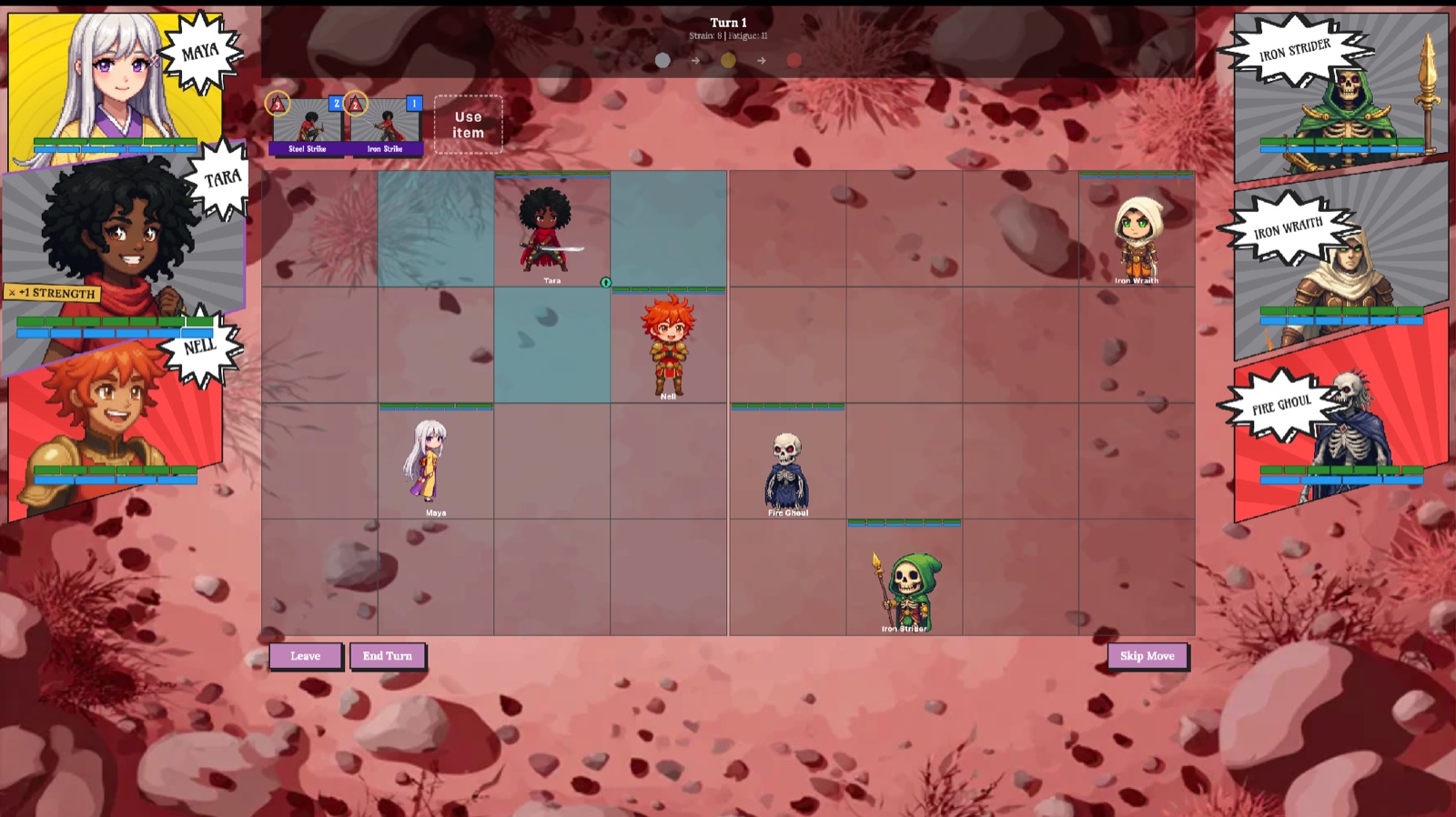
Claude and I were working on a fight where the player hits the wall in 90% of cases — every hero in the party knocked out. Which is too many. We tried a couple of the levers we have: we stopped enemies using pack mentality, so they act as individual units instead of piling onto one hero, and we made enemy spells weaker than hero spells at generation. It moved the needle, but not far enough. So I said: go ahead, deary, give me your ideas.
It immediately came up with the most genius idea ever. Let's make the enemies less aggressive!
Sounds logical, right? You would assume enemy aggression has something to do with how hard a fight is.
In Larithea it does, but the other way round. Aggressive enemies move forward more often, which puts them in range of more of my heroes' spells. So aggressive enemies are the EASIEST ones to knock out. Evasive enemies are the hard ones — they move side to side or stay put, so you have to plan around them and can only win by lining up spells with the right reach.
I told Claude exactly what I thought of the suggestion, we had one of the exchanges my partner calls "Inga screaming at a calculator", and we moved on.
This happens to me regularly. Claude gives a generic suggestion that would make sense in 80% of cases. In the other 20% it makes no sense, or has literally the opposite effect.
So the most important part is knowing which 20% is yours. And that does not mean writing those parts by hand. Claude can still write the code, that is not a problem. The problem is not knowing the logic of your own product, and so being unable to say "this is crazy" when Claude goes crazy.
It is not really an engineering thing, as far as my experience shows. It sits closer to the individuality of your project, the part that makes your offering unique. Do you really care whether your frontend runs on Netlify or Vercel? Probably not. But you do care when you ask AI to make fights easier and it makes them harder.
How do you find your 20%? That is a very interesting adventure everyone should embark on. If you don't know them, you don't know your product. And it should make you sad.